



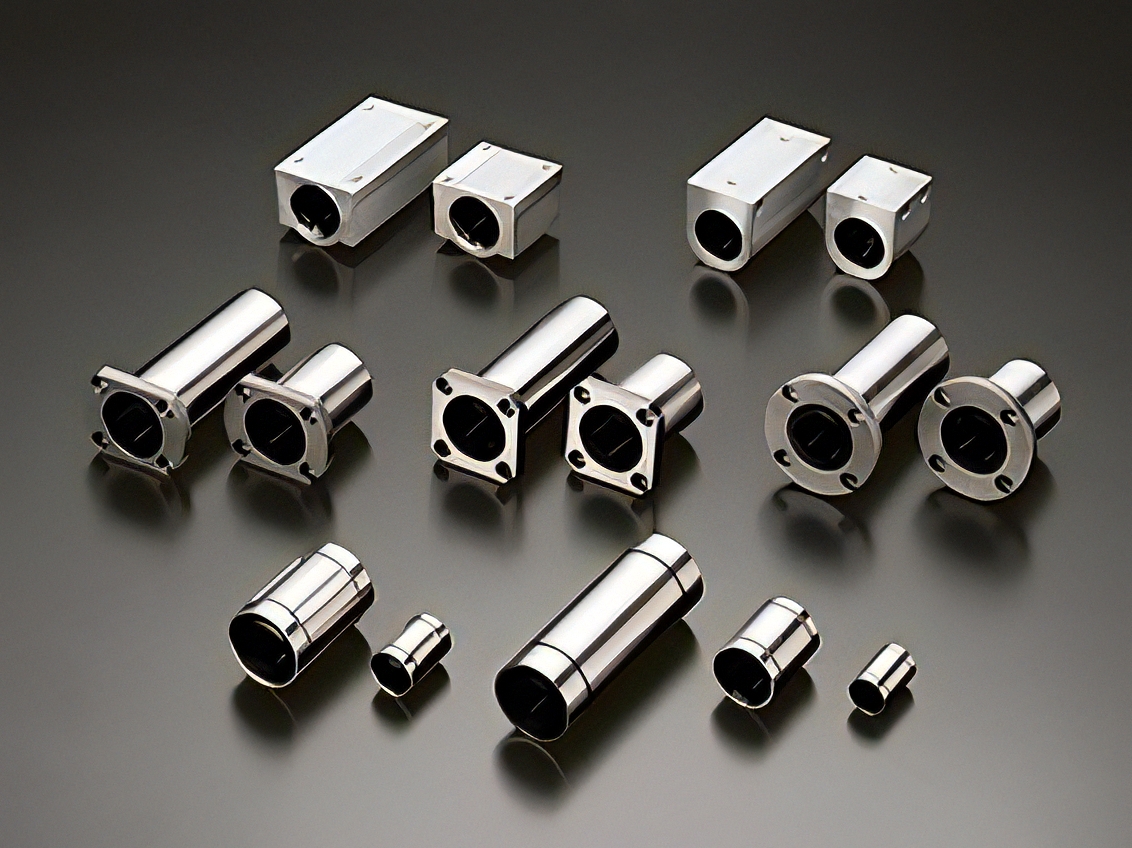
1. Everyone knows that Shangyin guide rails, also known as slides, linear slides, are called in mainland China.
2. The upper silver guide rail is often used for linear reciprocation. It has a higher rated load than linear bearings and can withstand a certain torque to achieve high straight lines under high loads. It is further divided into square ball, double spindle roller, and single spindle.
3. The linear function of the upper silver guide rail is used to support and guide, and make a reciprocating straight line according to a given direction. According to the nature of friction, linear guide rails can be divided into sliding friction guide rails, rolling friction guide rails, elastic friction guide rails, fluid friction guide rails and other types. Linear bearings are mainly used in automated machinery, such as machine tools, bending machines, laser welding machines imported from Germany, etc. Of course, linear bearings and straight shafts are matched. Imitation is mainly used in high mechanical structures
4. When the upper silver guide rail is combined from a circular groove, during installation, the elastic deformation and the transmission of the contact point through, even if there is a certain deviation in the installation surface, it can be absorbed by the line rail slider, resulting in the effect of automatic self-aligning ability and obtaining high stability and smoothness. Due to the strict control of manufacturing, the size can be maintained at a certain level, and the slider has a stopper design to prevent falling, so the parts of this series are interchangeable. Customers can order guide rails or sliders as needed, or they can store the guide rails and sliders separately to reduce storage space. Adopting four rows of circular arc grooves, with four rows of 45-degree contact angles, the ideal two-point contact structure can be achieved, capable of withstanding loads from up and down and left and right directions; preloading can be performed to improve stiffness if necessary.
When the upper silver guide rail machine is working and moving, in the groove of the bracket domestic circulation, the wear of the bracket is distributed to each one, thus prolonging the service life. In order to eliminate the gap between the bracket and the guide rail, preloading can improve the stability of the guide rail, preloading. It is mounted between the guide rail and the bracket extra large. The diameter tolerance is ± 20 microns, sieving and grading are carried out in increments of 0.5 microns respectively, and loaded on the guide rail. The size of the preload depends on the force acting on it. If the force acting on it is too large, the preload time is too long, resulting in an increase in the resistance of the bracket. There is a balance here; in order to improve the sensitivity and reduce the resistance, the preload force should be reduced accordingly. In order to raise and maintain, sufficient negative preload is required, which are two conflicting aspects.
When the upper silver guide works for too long, it starts to wear out, and the preload load on it starts to weaken, resulting in a decrease in the work of the machine tool. If you want to keep the initial, you need to replace the guide bracket, or even replace it. If the guide has been preloaded. Has been lost, the solution is to replace the rolling.
When the guide rail is designed, it strives for the maximum contact area between the fixed and the moving, so that it can not only improve the bearing capacity, but also withstand the impact force of intermittent cutting or gravity cutting, which is widely diffused and expands the bearing area. In order to achieve this, the guide rail has a variety of groove shapes. There are two representative ones. One is called the Gottley type (pointed arch), its shape is an extension of half a garden, and the contact point is the vertex. The other is the arc, which can play the same role. No matter which structural form, there is only one purpose, to strive for more rolling radius to contact the guide rail (fixed member). The key factor that determines the performance characteristics is the way the rolling contacts the guide rail.