



Compared with the plane guide, the geometric shape of the cross section of the linear guide is more complicated than that of the plane guide. The reason for the complexity is that grooves need to be machined on the guide to facilitate the movement of the sliding elements. The shape and number of grooves depend on the function to be completed by the machine tool. For example, a guide system that accepts both linear force and overturning torque is very different from a guide that only accepts linear force.
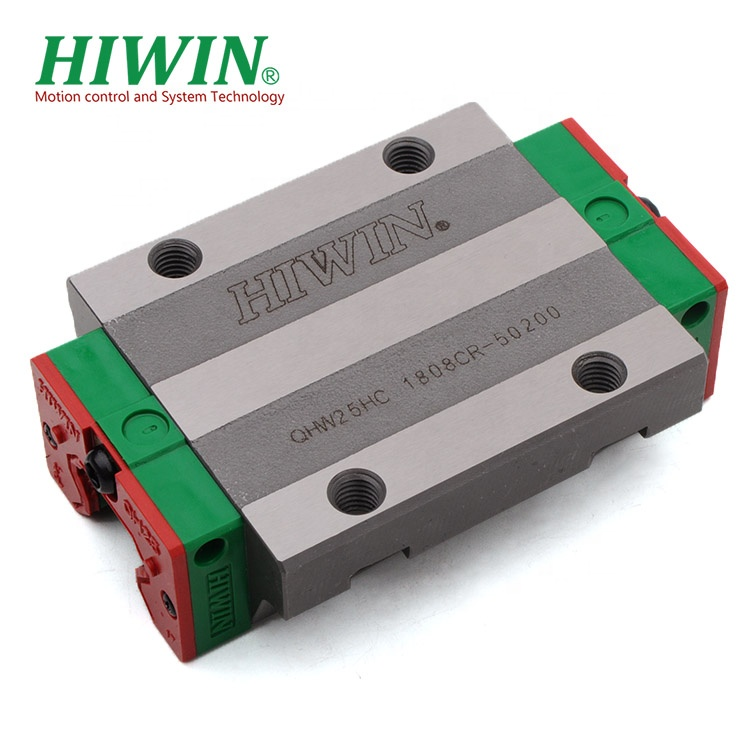
There is no intermediate medium between the moving elements and the fixed elements of the linear guide rail, but a rolling steel ball is used. Since the rolling steel ball conforms to high-speed motion, has a small friction coefficient, and has high flexibility, it meets the working requirements of moving parts, such as the tool holder of the machine tool, the drag plate, etc. The fundamental function of the fixed element (guide rail) of the linear guide system is like a bearing ring, a bracket for installing the steel ball, and the shape is "v". The bracket wraps the top and two sides of the guide rail. In order to support the working parts of the machine tool, a set of linear guides has at least four brackets. For supporting large working parts, the number of brackets can be more than four.
When the working parts of the machine tool move, the steel ball circulates in the bracket groove, distributing the wear amount of the bracket to each steel ball, thereby prolonging the service life of the linear guide rail. In order to eliminate the gap between the bracket and the guide rail, the pre-load can improve the stability of the guide rail system, and the pre-load is obtained. It is to install super-sized steel balls between the guide rail and the bracket. The diameter tolerance of the steel ball is ± 20 microns, and the steel balls are selected and classified in increments of 0.5 microns. They are installed on the guide rail separately. The size of the pre-load depends on the force acting on the steel ball. If the force acting on the steel ball is too large, the steel ball is prohibited from being pre-loaded for too long, which will cause the movement of the bracket to increase the resistance. There is a problem of equilibrium here; in order to improve the flexibility of the system and reduce the resistance to motion, the preload should be reduced accordingly, and in order to improve the accuracy and consistency of the accuracy, it is required to have enough preadded negative numbers, which are two contradictory aspects.