



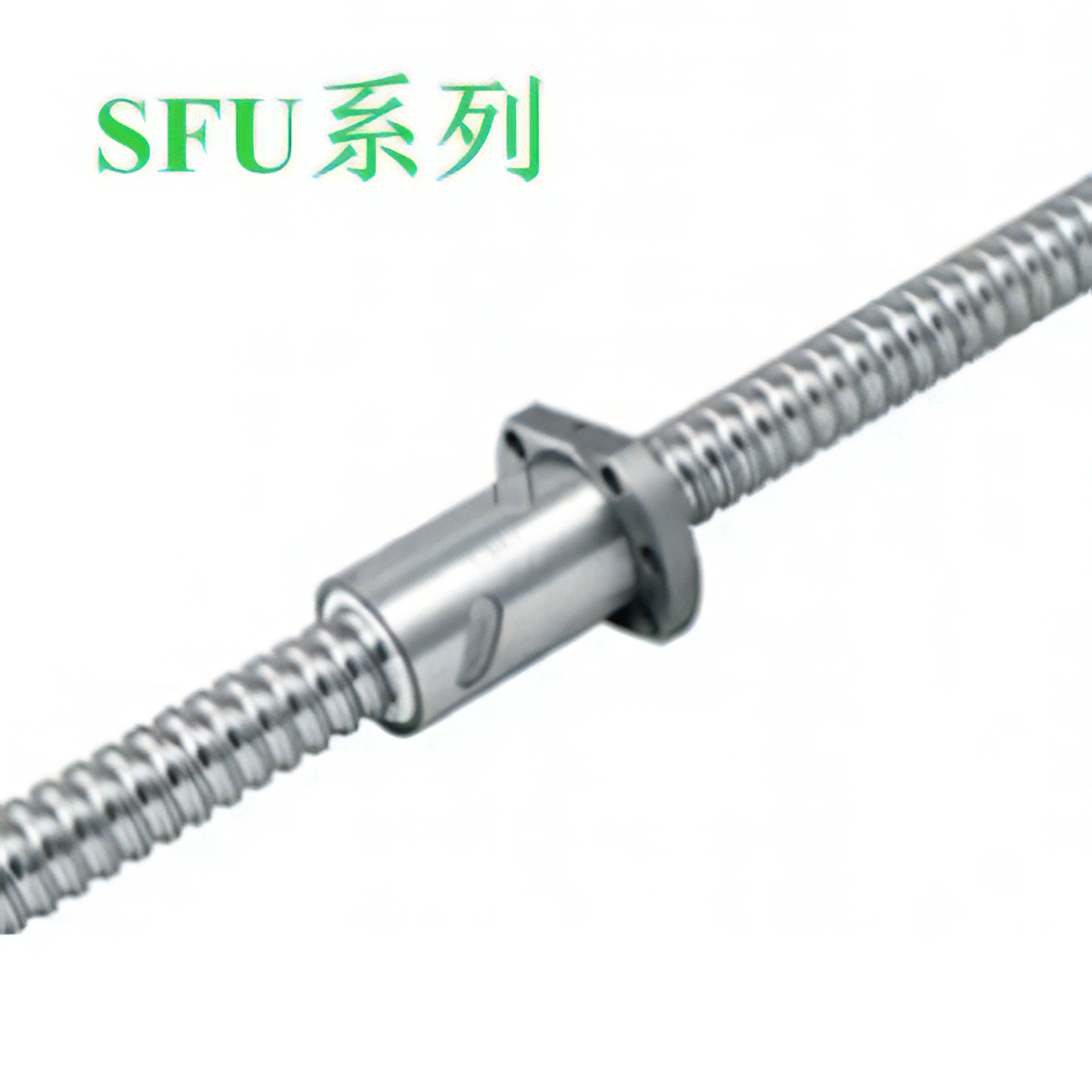
It can be understood as a rolling guide, which is made of steel balls in an infinite rolling cycle between the slider and the guide rail, so that the loading platform can easily move in a straight line with high precision along the guide rail, and the friction coefficient is reduced to 50 times that of the usual traditional sliding guide, which can easily achieve high positioning accuracy. The final unit design between the slider and the guide rail, so that the linear guide can bear the load in all directions at the same time. The patented return system and simplified structural design make the upper silver linear guide move more smoothly and with lower noise.
Upper silver guide rail slider - change the movement from curve to straight line. The new guide rail system enables the machine to obtain a faster feed speed. In the case of the same spindle speed, fast feed is the characteristic of linear guide. Linear guide is the same as the plane guide and has two basic components; one as the guide of the fixed element and the other as the moving element. Because linear guide is a standard component, for machine tool manufacturers. What needs to be done is to make a plane to install the guide and adjust the parallelism of the guide. Of course, in order to ensure the accuracy of the machine tool, a small amount of scraping and grinding of the bed body or column is essential. In most cases, the installation is relatively simple. The guide rail is quenched steel and is placed on the installation plane after fine grinding. In comparison to planar guides, the cross-sectional geometry of linear guides is more complex than that of planar guides. The reason for the complexity is that the guides need to be machined into grooves to facilitate the movement of sliding parts. The shape and number of grooves depend on the function of the machine to be completed. For example, a guide system that bears both linear and overturning torques can be compared to a guide system that bears only linear forces. There are significant differences in design.
The basic function of the fixing unit (guide rail) of the upper silver guide rail linear guide system is similar to the bearing ring. The bracket used to install the steel ball is in the shape of a "V". The bracket wraps the top and sides of the guide rail. In order to support the working parts of the machine tool, the linear guide has at least four supports. For supporting larger working parts, the number of brackets can exceed 4.
When the working parts of the upper silver guide rail machine tool move, the steel ball is in the groove of the bracket for domestic circulation, which distributes the wear of the bracket to each steel ball, thus prolonging the service life of the linear guide rail. In order to eliminate the gap between the bracket and the guide rail, the preloading can improve the stability of the guide rail system and carry out preloading. It is to install an extra large steel ball between the guide rail and the bracket. The diameter tolerance of the steel ball is ± 20 microns. The steel balls are sieved and graded in increments of 0.5 microns respectively, and loaded into the guide rail. The size of the preloading depends on the force acting on the steel ball. If the force on the steel ball is too large and the preloading time is too long, resulting in an increase in the movement resistance of the bracket, there will be a balance effect problem; in order to improve the sensitivity of the system and reduce the movement resistance, the preloading force should be reduced accordingly. In order to improve the movement accuracy and maintain the accuracy, sufficient negative preloading is required, which are two contradictory aspects.
The upper silver guide rail works for too long, the steel ball starts to wear, and the preload force on the steel ball starts to weaken, resulting in a decrease in the movement accuracy of the working parts of the machine tool. If you want to maintain the initial accuracy, replace the guide rail bracket, or even replace it. If the guide rail system has been preloaded. System accuracy has been lost, the solution is to replace the rolling elements.
The design of the upper silver guide rail system strives to make a large contact area between the fixed unit and the mobile unit, so that not only can the bearing capacity of the system be improved, but the system can also withstand the impact of intermittent cutting or gravity cutting. The force is widely diffused and the bearing area is enlarged. In order to achieve this, the guide rail system has a variety of groove shapes. There are two representative ones. One is called Gothic (pointed arch), and its shape is an extension of a semicircle with the contact point as the vertex. The other is a circular arc, which can also play the same role. No matter which structural form, there is only one purpose, to strive for more rolling steel ball radius to contact the guide rail (fixed element). The key factor that determines the performance characteristics of the system is the performance of the rolling element